
DISCOVER AND CULTIVATE YOURSELF
To further immerse you in the CollageMente experience, in this section we offer:
- A SELECTION OF BOOKS ON COLLAGE
- A SELECTION OF BOOKS MENTAL HEALTH
- A SELECTION OF MENTAL HEALTH PAPERS
You can find them online or at your local bookstore, and of course there are many more than those we share here.

TRAINING OUR ARTISTIC EYE
Observing the work of other authors, historical or contemporary, enriches us and educates our gaze. This helps us to acquire criteria and aesthetic knowledge and helps us to define our own personal taste, and, consequently, to connect with our own personality. Also very interesting are the catalogs of artists, these are usually found in museum stores.
some books on collage theory and artist directories

some collage activity books

READING TO UNDERSTAND OURSELVES
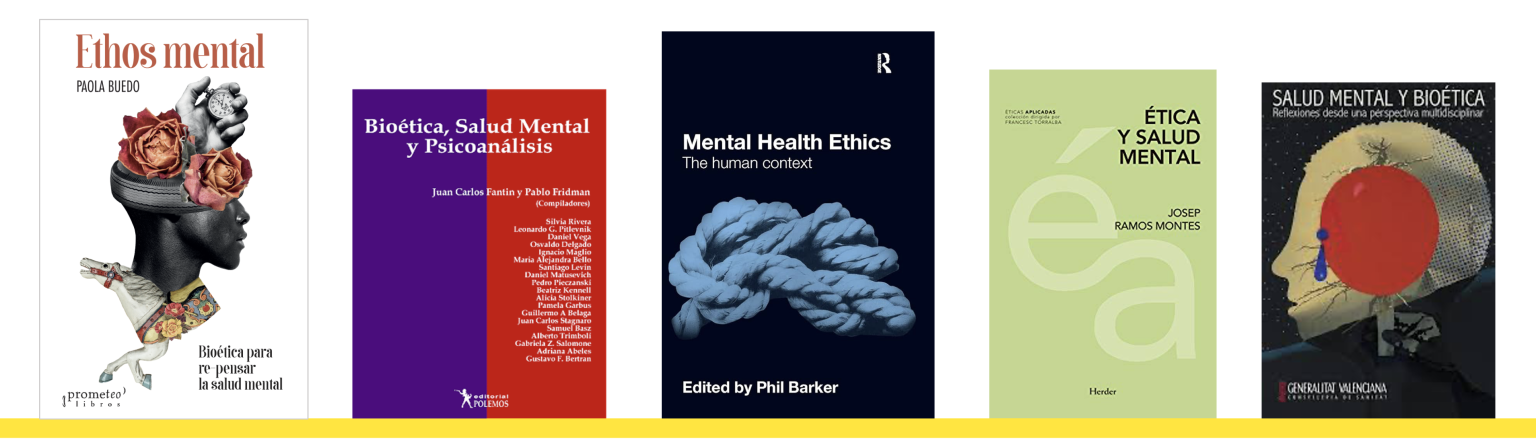
Some books about mental
health and bioethics
Reading about mental health from an ethical perspective helps us understand ourselves better, our attitudes, emotions, behaviors, and ways of relating. It is also important to have a different view of other people and their subjectivities. Knowing more about mental health makes us more tolerant and better prepared to face uncertainties, pain and frustration.
scientific publications on mental
health and bioethics
by paola buedo
Grounding Mental Health in Bioethics
The article «Grounding Mental Health in Bioethics», published in Nature Mental Health, explores how bioethics is central to the approach to mental health. It proposes three key concepts:
– Social justice, to address social factors such as stigma and inequality in mental health;
– A focus on the patient experience, promoting empathy and addressing epistemic injustice;
– Integrative therapies, those that strengthen the psychosocial aspects and autonomy of the person suffering.
GRETA THUNBERG SEEN THROUGH THE LENS OF MENTAL HEALTH ETHICS
The article «Greta Thunberg Seen Through the Lens of Mental Health Ethics», published in the Journal of Psychiatric and Mental Health Nursing, reflects on the situation of Greta Thunberg, who felt the emotional impact of climate change from a young age. Diagnosed with Asperger’s Syndrome, Obsessive Compulsive Disorder and Selective Mutism, her suffering was seen as a mental health problem, but her distress had a legitimate cause: inaction in the face of the environmental crisis. Through his Fridays for Future movement, she found purpose and built a community, showing that for many, activism is a way to turn pain into action. We need an ethical vision of mental health that recognises the social and environmental context in which we live, because «there is no mental health on a dying planet».
Strengthening Autonomy in Mental Health
Care Through a Relational Approach
The article «Strengthening Autonomy in Mental Health Care Through a Relational Approach» published in Nature Mental Health argues that the classical approach to autonomy, based on independence, individualism and rationality, is insufficient for the mental health field. It proposes a relational autonomy model that recognises how social factors, stigma and relationships influence decision-making capacity. This approach promotes ethical care that respects the moral agency of people with mental illness.
Bioética feminista:
un marco para pensar la autonomía en salud mental
The article «Bioética feminista: un marco para pensar la autonomía en salud mental» (Feminist bioethics: a framework for thinking about autonomy in mental health), published in the journal Redbioética/UNESCO, argues that inequalities between men, women and LGBT+ people seriously affect mental health. It is important to reflect on how the health system and society can perpetuate these inequalities and thus increase the prevalence of mental illness. Feminist bioethics helps us to rethink the way we treat mental health so that all people can exercise their autonomy and receive the respect they deserve. It also helps us to recognise the conditions that influence mental illness and decision-making, both of which are key to improving mental health treatment and care.
A contextual understanding of the high prevalence of depression
in Latin America
The article «A contextual understanding of the high prevalence of depression in Latin America», published in The Lancet Regional Health – Americas, analyses the high rates of depression in Latin America and criticises the tendency to focus solely on neurobiological explanations. It argues that factors such as violence, poverty and political instability are crucial to understanding depression in the region. It proposes a contextual approach that recognises the cultural and social specificities of Latin America, such as social cohesion and culturally supportive practices, in order to effectively address mental health.
Toma de decisiones compartidas en salud mental:
una propuesta novedosa
The article «Toma de decisiones compartidas en salud mental: una propuesta novedosa» (Shared decision-making in mental health: a novel proposal), published in Medicine and Ethics, proposes a new way of approaching decision-making in mental health by focusing on relational autonomy. In contrast to the classical view of autonomy, which can be limited by mental suffering, this approach highlights how social and contextual relationships influence people’s decisions. Shared decision-making between professionals, patients and families fosters a collaborative process that supports patients’ autonomy and promotes their well-being without stigmatising them or making them vulnerable.
Applying Ethics to Mental Health and Climate Change
The article «Applying Ethics to Mental Health and Climate Change», published in Academic Psychiatry, raises ethical considerations on the climate crisis and mental health, highlighting the importance of avoiding stigmatisation of vulnerable groups and challenging the pathologisation of climate change-related distress. It also suggests alternative approaches to coping, such as park maintenance and environmental activism, to strengthen both individual well-being and collective action.